









A haunting meditation on humanity, cruelty, and survival disguised as dystopian fiction. Based on Stephen King’s early novel (written under the Richard Bachman pseudonym), The Long Walk follows 50 boys and young men forced to participate in a government-sanctioned competition where the only rule is simple: keep walking, or die.
Unlike other dystopian blockbusters such as The Hunger Games, this film rejects glossy action and world-building excess in favor of stark minimalism. The road they walk is empty, and so is much of the film’s visual landscape, forcing the audience to focus on the people, their words, and the brutal simplicity of their ordeal.
Director Francis Lawrence approaches the material with remarkable restraint. The film unfolds almost entirely in conversation, relying on raw, unpolished performances to carry emotional weight. The cast delivers dialogue that feels heartbreakingly authentic, intimate exchanges that evoke a time before constant connectivity dulled the urgency of face-to-face conversation.
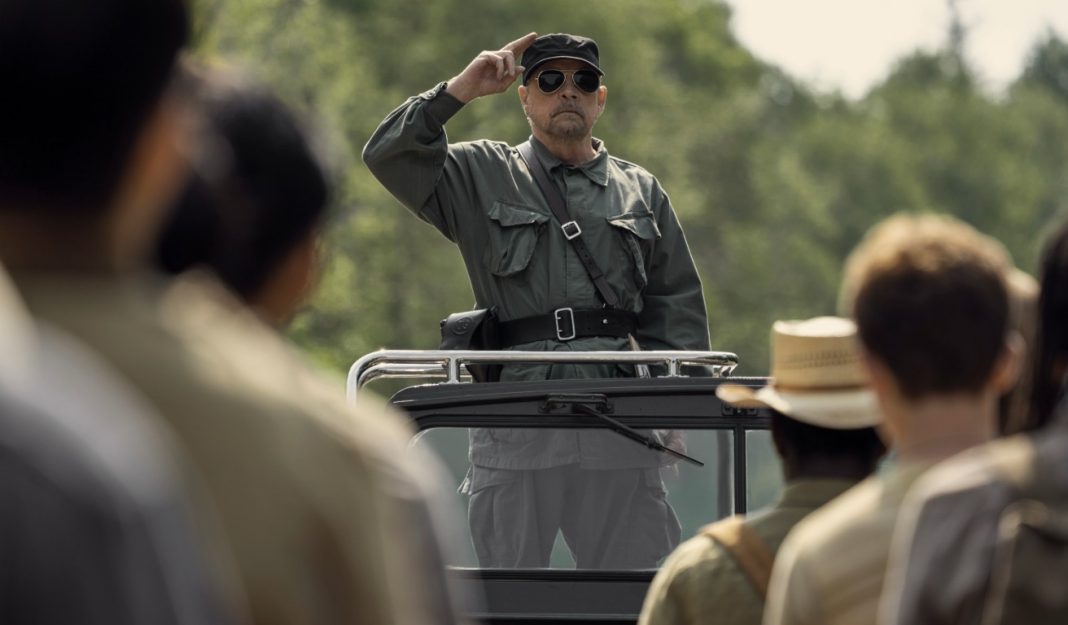
This stripped-down approach is not only refreshing but also deeply unsettling. There is nowhere for the viewer to hide from the characters’ suffering or from their attempts to cling to humanity as the bodies around them fall.
RELATED: ‘The Institute’ Stars Discuss the Pressures of Starring in a Stephen King TV Adaptation (Exclusive)
King wrote The Long Walk during the height of the Vietnam War, and this adaptation never shies away from that context. The parallels are chilling: a generation of boys sent to endure something monstrous in the name of patriotism, told it is “for the greater good.” The story’s dystopian future feels less like fantasy and more like an allegory, a mirror reflecting the trauma of young men asked to march toward death with no clear reason other than loyalty to a faceless government.

One exchange in particular lingers long after the credits roll. Following the execution of another participant, shot after his third and final warning, a boy quietly mutters, “I hope this gets easier.” To which Garraty (Cooper Hoffman), one of the film’s most quietly compelling characters, replies, “That’s what I’m afraid of.” It is a line that encapsulates the film’s greatest terror: not the inevitability of death, but the danger of becoming desensitized to it.
RELATED: Author Keith Rosson Talks ‘Coffin Moon’, Love for Horror, and Praise from Stephen King (Exclusive)
The Long Walk is not an easy watch, nor is it meant to be. By eschewing spectacle, it achieves something far more resonant than any action set piece could offer: a raw and deeply human exploration of friendship, fear, and resilience in the face of senseless brutality. It is a film that demands patience, empathy, and reflection, and in doing so, it earns every heavy step its characters take.
Originally published on Letterboxd.