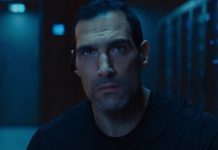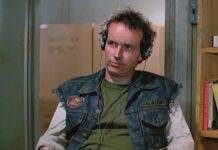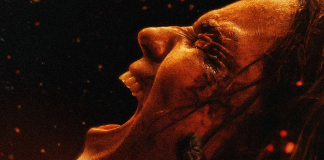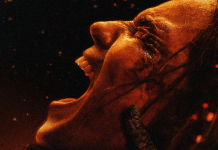


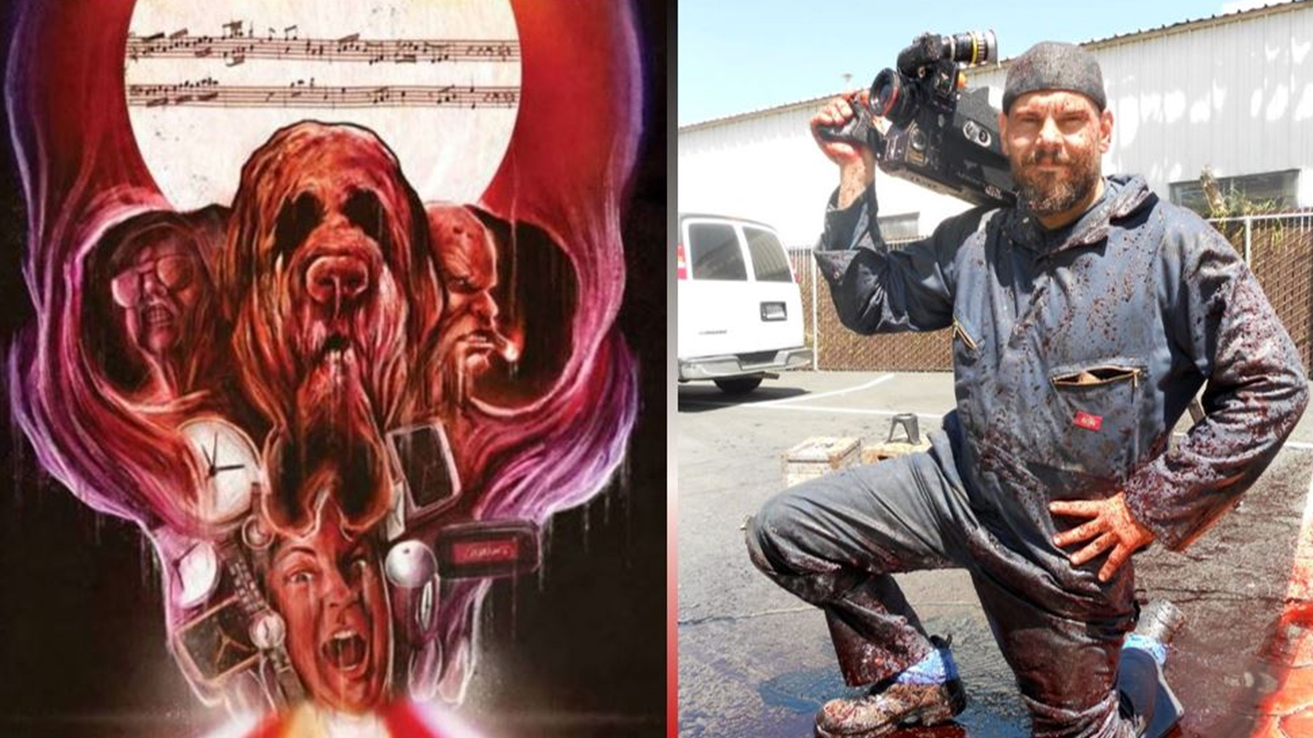
Practical FX legend and film director Gabe Bartalos has been working hard on unforgettable horror and cult films for over 30 years. His work can be seen in iconic films like Leprechaun, Brain Damage, Dolls, Frankenhooker, and the Basket Case sequels. We caught up with Bartalos to talk about his new film, Saint Bernard, and to discuss his career.
Check out our review of Saint Bernard here!
Horror Geek Life: When you watch a film with Gabe Bartalos FX, you can always tell. What inspired your trademark visual style?
Gabe Bartalos: I guess that however people perceive that style, I try to pull from different source material than some of my contemporaries. I may be a lot more interested in the inside of tree bark or a really messed up piece of kelp I find at the bottom of the ocean, with the webbing and textures than others might. Then I apply that mosaic, that orgy of crisscrossing, I try to get that into some of the sculptural or cosmetic detail I do.
It seems to work well in that it conveys the aggro, the energy, and the tenacity I’m trying to convey if that’s what a sculpture lends itself to. And at the same time, it may be a subconscious form of making it universally accepted because it’s coming from an organic source, something that we all, even biologically, can relate to.
HGL: Your new film, Saint Bernard, is a wonderfully unconventional narrative. What can you tell us about the process of writing a film that abandons some of those classic narrative rules?
Gabe Bartalos: You know, I think we’re all good at criticizing things, but when it comes the time to “be the change you want to see,” that’s where it comes down to character in motion. I sometimes feel frustrated that the amazing canvas and medium of cinema isn’t fully exploited. You have all these tricks at your disposal. I think that film is actually a form of language. So, I started with my straight one-line description of a musical composer who descends into madness. That came from the things that I’m interested in — music, art, and brain disorders. Take those three and write a script that plays to your strengths.
Then I thought to myself, if we’re going to try and visualize a troubled mind and convey it through a dream state, I wanted to approach it in a more cinematic way. I was trying to find a language that would resonate with the viewer so that if you were to write out a synopsis of each scene, it would seem nonsensical, but to a person who has seen the film, they would realize or feel that it all does connect.
RELATED: Exclusive: The Master of Splatter, Todd Sheets, Talks ‘Clownado’ and SOV
I wanted it to connect in the way that a dream connects. When you’re in a dream, as extreme and nonsensical as the scenarios may feel, in that moment in the dream, they absolutely feel real. They totally make sense, they have consequences, and they have an impact. It’s only when you’re out of the dream when you reflect on it you kind of chuckle, “What the heck was that?” I wanted to see if I could convey that same kind of mood and dream logic to an entire feature film. It allowed me to leverage my imagination to push the scenarios to extremes, but my biggest task at hand at the same time was making sure the umbrella and the pedigree all felt like they could happen in this Saint Bernard universe.
Even if it didn’t make sense instantly, it still was coming from the same well. That tone and overview are always one of the most important jobs of the film director. It was always a work in progress, especially when the picture was edited, and we moved into the sound design and the music. I’d ask, is it still casting that same spell?
HGL: Both of your directorial efforts, Saint Bernard and Skinned Deep, have a surrealist sensibility. You’ve kind of touched on this already, but what is it about that style that attracts you?
Gabe Bartalos: It pushes me to consider what I’m doing a little further. I think that we all function day-to-day because of our subconscious a lot more than we realize. I heard this amazing fact about train crashes. There was a statistic from people who were researching ESP, and there’s a school of thought that 10,000 years from now, ESP will be a fully-developed sense. That there are a few now who have it, a few that have it at subtle levels, some not at all. There’s a theory that when you’re going to work and you always take a right at the same light, hundreds of times in your life, that the one day you go, “Fuck it, I’m gonna go straight, or take a left,” that you’re actually responding to some extra sensory perception that’s telling you to stay away from there. Or they say that you have a “gut feeling” about something, you meet someone in a business situation, and you say, “You know what? I’m gonna pass,” but everything sounded great, it was a gut feeling. That it’s not actually in the gut, it’s a cerebral thing, and it’s an undeveloped form of ESP.
Going back to what I was saying, they did an examination of train crashes, and they found that the people who were daily commuters with their briefcases and overcoats sludged on that train, at times of train crashes, there was an odd disproportionate amount of commuters that did not go to the train that day. For whatever reason, said, “You know, I’m gonna stay with my kid,” or work from home. They didn’t have a tangible reason. That’s just reinforcing interest in that we do get information from our subconscious more than we realize.
The billboard advertisers know it. They know that even if you’re not looking, you’re paying attention, whether you’re driving or walking. That billboard is getting in your peripheral vision. They depend on that. Billboards would not exist if it was not working for them. So, there’s a very real sense of subliminal information manipulating our behaviors. One could even argue that a connection that’s made at a subconscious level is actually going to resonate more than what hits you, you digest it, and you spit it out.
RELATED: Exclusive: Tim Ritter Talks ‘Killing Spree,’ ‘Hi-Death,’ and Underground Horror
So for me, making films, I want to try to take it seriously and try and have it resonate at a level that’s more interesting for me to make. Something like Saint Bernard is not for everybody, but those who enjoy that stuff may not only enjoy it, but it may really resonate at different levels for them. That’s kind of where the surreal, dream-like feels come from. I also enjoy that stuff, I like when things are slightly in metaphor or symbolism. It almost feels like it’s respecting my intellect. When I see something that works on an abstract level, that does communicate to me. It excites me.
So, I thought if I’m making a film of my own, I want to reward the viewer, I know there are a lot of choices out there. I want them to see I worked hard to give them images they’ve never seen before and, at the same time, communicate through that language of film in a slightly different way that it may hit at another level.
HGL: Warwick Davis has appeared in both of your films, but you also have a history with him from working on the Leprechaun film series. What can you tell us about your history with that series and working with Warwick?
Gabe Bartalos: Well, the initial working relationship with him was on Leprechaun. We became fast friends. I learned what the public has learned from his recent TV shows, that he’s wickedly funny. He has a great sense of humor. And he’s just an amazing actor. Through the many hours in the make-up chair for the various sequels to the Leprechaun films, we became friends. When I was telling him about my first feature film, Skinned Deep, and I was envisioning these parts, I cautiously approached him. I left the door open so that if he wanted to participate, I was really excited. I knew that half the time, he’s on Star Wars sets, so I’m not expecting him to change gears like that, but he was happy to participate. His involvement was significant.
I wrote the most lunatic character, Plates, and it takes someone with real acting chops to legitimize that kind of dialogue. On the first day of shooting, he said asked me what the motivation was for this character. Who is this guy? I just said the motivation would be that you guzzled three pots of coffee, that’s the vibrato energy level you need to be at. Just teeth clenched, holding back rage, and your output is the throwing of plates, the act of violence. And he totally manifested that! It was one of those things where I was like, “Ah, no wonder you’re an A-list actor and considered in such high esteem.” So, it led me to him again for the character called Othello, the guy who guards the log pile in Saint Bernard, who was also kind of an absurdist character, but I kind of saw that character as one of the few guardian angels in the film. The Bernard character is staggering through these situations that represent his mental decay, and Warwick appears to him, realizing that Bernard needs time. So he grants him some time, which allows him to propel his journey to wherever the conclusion may be.
RELATED: 10 Terrifying Horror Movies That Will Keep You Up at Night
Warwick would laugh, he knows that I like to explore things in different ways, and he’s like, “Ok! Guardian angel! I didn’t really see that when I read the script, but that’s good to know.” It wasn’t necessarily there to inform his character, but I like giving the information at a different level because an actor may pick up on that, even in their gestures. Are they evil? Are they good? And Warwick’s character was a good force. He’s got his own rules, and he lives with his logs, and he’s got his own peculiarities, but at the end of the day, he’s a positive force. Warwick and the star of the film, Jason Dugre, watching them together was really excellent. It was a really nice ping-ponging of talents.
HGL: Tell us a little about your working relationship with director Frank Henenlotter.
Gabe Bartalos: It’s a wonderful relationship, and I’m really thrilled that it’s become a friendship and it’s grown that way from the purest of ways. I was a fan of Basket Case before I ever met Frank. I saw this film, and I couldn’t believe its outrageousness. Frank tends to criticize the film for its modesty, but to me, its shortcomings financially were like a declaration of its creativity. It was a perfect example to say, “Look, creativity is not about the budget. It’s about the ideas.”
Basket Case is heartfelt, it’s outrageous, it’s violent, and it had meaning. You know, it’s all these things that you go, “I can’t believe I can assign all these things to this insane little film!” Then when I met Frank and was asked to join the team for Brain Damage, it made a lot of sense. I met a very compassionate, very smart, funny guy who was always up for telling stories. So many of his films have survived the test of time and are considered reviewable and are reissued, that’s not accidental, there is this great brain behind it. We’ve had wonderful collaborations that have been very satisfying for both of us.
He said recently, in an interview about Elmer from Brain Damage, he said that though he’s the director and everything seems to point towards him, Elmer is something we’re both very proud of and can both hold ownership of. I thought that was really cool because whenever I build stuff, though it comes from my hands, it’s to serve the film and the director, but Frank was like nah, he built it, he came up with it. Frank had concepts in his head, and he guided me as I sculpted it. He may not be the guy to have the sculpture skill set or wardrobe, that’s why you get department heads. So there was so much of each of us infused in that it was a flattering and interesting way to put it that we both claim Elmer as our baby (laughs). I thought that was very generous of him to say.
HGL: Lastly, you’ve been working in the special FX field for over 30 years. How would you say you’ve been able to remain active for so long in a field that has evolved so much over the years?
Gabe Bartalos: That’s a great question. I think a lot of it is luck. I consider myself really fortunate that on a lot of the jobs I do, the filmmakers invite me back. That’s exciting because you can grow with the filmmaker. You begin to understand them and their source material, and a shorthand develops. I’d say that’s the same for Matthew Barney, Frank Henenlotter, Kevin Tenney, and Stuart Gordon. These are all people I hold in high esteem.
RELATED: ‘Maniac Cop’ Is One of Horror’s Most Underrated Slashers
Maybe that’s part of it, too. I respect what they’re doing and feel like it’s a privilege to work on their films. It translates to me being fully attentive and trying to deliver the best. They’ve proven, and others, that they’ve been able to make films that people like. So, one tends to complement the other. If I’m able to bring something to a film that helps define the narrative, or if I’m lucky enough to have been able to develop my own style that stands out or speaks to the film, that it’s good for everybody. The tide rises for all. To have been able to jump back and forth, to write and direct my own films, helps keep the balancing act. There’s no threat of monotony.
Since makeup FX and creature design are still the primary functions of my studio, Atlantic West Effects, when I do make a film, it does take longer than others. I take my time to try to get it right and make sure I challenge myself. It also mixes it up a little, it keeps it really fresh. I think maybe all of those moving parts helped to somehow define the longevity, I know they’ve certainly helped (laughs).
Saint Bernard releases on Blu-ray, DVD, and digital platforms on May 14th from Severin Films. Check out a new clip featuring Warwick Davis and Jason Dugre below!