










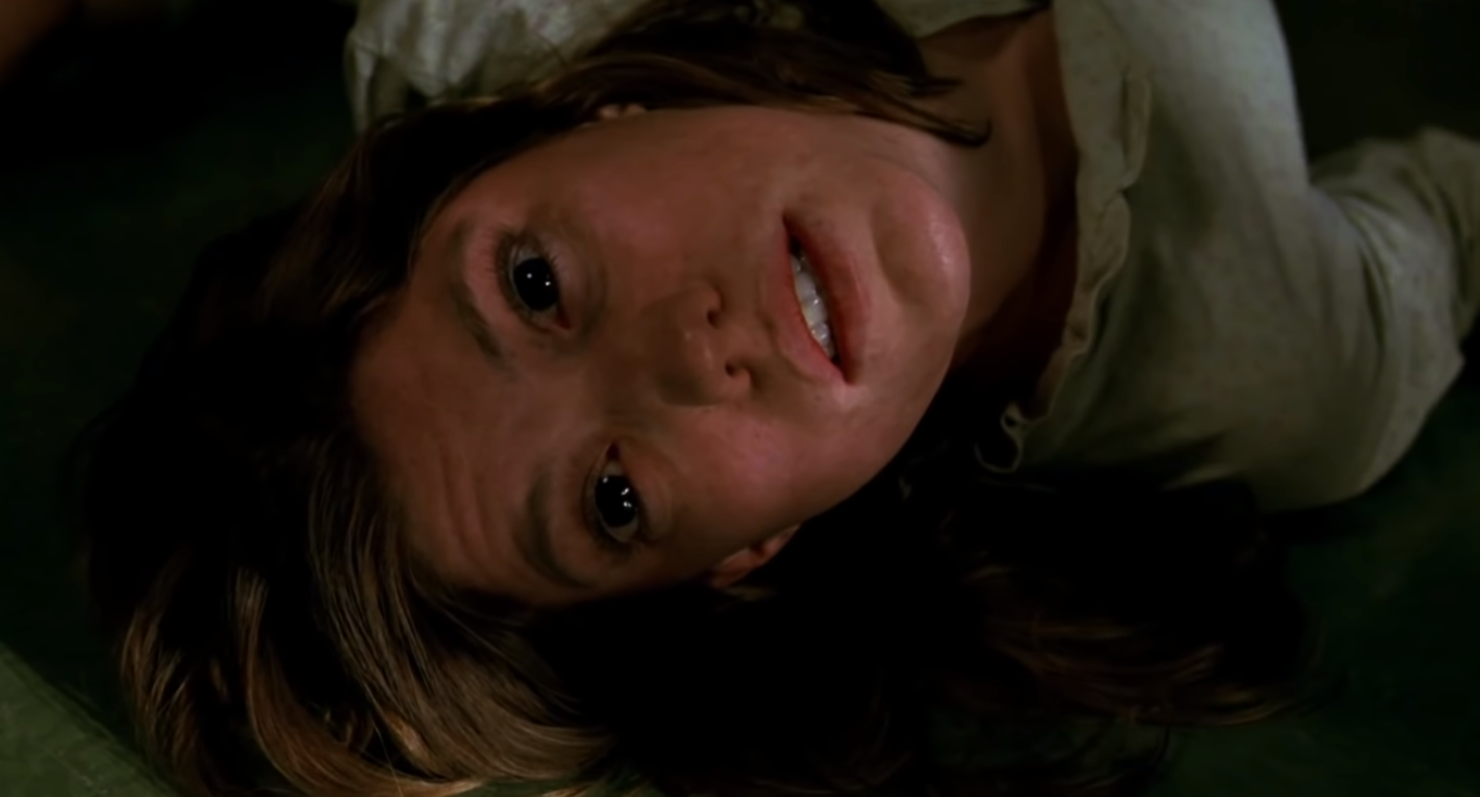
In 2005, The Exorcism of Emily Rose marked the beginning of a return to the somewhat stale possession-and-exorcism subgenres of horror. Told mainly through the portrayal of Emily herself, played by Jennifer Carpenter, and her haunting body contortions, achieved without CGI. Upon rewatch, the film does fall into that obscure category of excorcinema, which, while boasting some frightening moments, holds more real-world implications than actual spooks.
The film subverts typical possession expectations by setting itself in the aftermath of a failed exorcism and the subsequent trial of the overseeing Priest, Father Moore (Tom Wilkinson). Charged with negligent homicide, Father Moore is defended by the Arch Diocese’s hire, crack defense attorney Erin Bruner (Laura Linney). Through the court proceedings, it explores Emily’s tragic story leading to her death, including the severe physical and psychological episodes that are perceived as demonic possession.
The film is based on a real, well-documented possession and court case.
The Exorcism of Emily Rose Was Inspired By Anneliese Michel’s Story
Anna Elisabeth (Anneliese) Michel was born on September 21, 1952, to parents Anna and Joseph Michel in the rural Bavarian community of Klingenberg. At 16 years old, she suffered her first of two severe convulsive episodes. Her second came shortly after she turned 17, and she was subjected to a series of EEGs to determine the cause of the malady.
At this point, many texts assert that Michel was diagnosed with epilepsy. However, testimony from her overseeing physician, Dr. Lüthy, during the court proceedings stated that she displayed “normal, physiological alpha-type brain activity.” She was given the anti-convulsive Zentropil and monitored on a regular basis.
After several illnesses, Michel had a third convulsion and was admitted to a psychiatric facility. There, her seizures were accompanied by screaming moans, and her body would convulse and contort, leaving her roommates terrified of her. She was despondent and would have daylight hallucinations of “devil’s faces” in clouds, trees, and art.
Michel grew averse to religious symbols, complaining of foul smells coming from the facility’s chapel, which she refused to enter. When not in the thrall of her afflictions, she came off as shy and mildly depressive, yet mostly normal.
RELATED: ‘The Conjuring’ Franchise: Every Warren Case That Has Been Explored So Far
A family friend of the Michel’s would regularly organize religious pilgrimages that Anneliese Michel attended. In 1970, on a trip to San Damiano, she refused to enter the shrine. Michel broke a rosary and was unable to drink the water from a Holy spring. Despite this, she still attempted to enter the consecrated grounds of the garden but found herself physically incapable of entering the gate. Her escort noted that, in all other respects, she seemed like a normal, shy girl and was visibly upset that she couldn’t participate like the other travelers.
The family friend became convinced Anneliese Michel was demonically possessed and shared this with her family. The priests could not verify her affliction as anything more than medical and refused to pursue an exorcism. Instead, she would add religious counseling to her treatment prior to returning to school.
No sooner did school start than she had another severe seizure. Further EEGs showed nothing untoward. She was regularly seeing Father Ernest Alt, in whom she confided the more spiritual interpretations of her state. Despite taking her medications, she would suffer bouts of absenteeism and body stiffening. She told Father Alt she was being “molested” by the demons during these episodes. When he witnessed one of the molestations, Father Alt recited the Lord’s prayer, and she was immediately freed from her torment.
Anneliese Michel went to University, but despite meeting and falling in love with a man named Peter, her symptoms worsened. She would see ghastly faces everywhere she looked. Despite disengaging from her studies, she did well in school and even made an impression on the university’s director, who took a personal interest in her health.
RELATED: 8 Modern PG-13 Horror Movies That Deliver the Thrills and Chills
She had another EEG at the director’s behest. Dr. Irmgard Scheip would finally state Michel did, in fact, have “epileptic patterns” in her brain cycles — however, the diagnosis of epilepsy was withheld pending further testing that would never come. The doctor surmised that the epilepsy, coupled with a previous diagnosis of her depressive psychosis from the psychiatric facility, was a reasonable explanation for all her symptoms.
She was taken off her previous medication and given Tegretol, a stronger drug to treat seizures but with more damaging side effects, including behavioral changes, depression, loss of appetite, and detachment from reality. The new course of drugs did nothing to prevent her seizures or psychotic episodes and, in fact, could have made them worse.
She grew physically aggressive towards herself and others. She drank her own urine and ate insects, which seemed to be the only nourishment she could keep down. She would frequently complain about horrid odors that no one else could smell and hear phantom banging on doors.
She would growl and shout in foreign languages like Latin and Aramaic, which, while she had access to them, were beyond her studies. By 1975, she chose to return home to her family, cut off all medical treatment, and seek refuge in faith alone.
Was Anneliese Michel a Tragic Case of Misdiagnosed Possession?
With Anneliese Michel’s consent and new evidence supporting their claims, Father Alt brought in priest Arnold Renz and received the necessary approval from Bishop Josef Stangl to perform the Ritual Romanum of 1619, also known as the Rites of Exorcism. Over the course of 10 months, beginning September 1975, the priests would perform 67 exorcisms.
Over time, the separation between Michel and her demons grew larger, and it was clear there was a young, tired girl completely separate from the demons possessing her. Eventually, the demons would identify themselves as six different entities: Belial, Judas Iscariot, Nero, Cain, Legion, and even Lucifer himself.
Near the end, she grew to believe her death would atone for the sins of youth and vanity. She stopped eating completely, hoping to weaken herself and, subsequently, the hold of the demons within her. By Christmas 1975, Father Alt reportedly began seeing his own visions: a living Christ on the Cross and a girl surrounded by brilliant light, accompanied by an ethereal chant, “For You.”
Her family supported her as best they could; however, they were afraid of Anneliese Michel. She was left under a table for two days, barking like a dog. She would defecate on the floor and be physically aggressive toward those attempting to clean it. Eventually, she became too weak and, on July 1, 1976, died of malnutrition and dehydration, weighing 68 lbs, missing teeth, her body bruised and tattered from the constant convulsions she was subjected to by the demons that tormented her.
And yet, Father Alt and Renz believed Michel was finally free of her demons in death, a modern martyr and a holy saint. Authorities, however, charged both priests and her parents with negligent homicide, and the case went to trial in March 1978.
RELATED: 7 Best Haunted House Horror Movies from the 1980s
A series of doctors testified about Anneliese Michel’s ongoing medical treatment and psychological diagnoses. They explained that her epilepsy, coupled with a paranoid psychosis exacerbated by her religious upbringing, left her uniquely susceptible to believing her condition was of demonic origin and, therefore, to consenting to all the physical and mental torment she endured.
After listening to more than forty recordings of the exorcism, the main concerns were whether anyone was encouraging her to eat or drink, and why no one with medical training was brought in to oversee Anneliese Michel’s health during the rites.
The defense, helmed by both Church-appointed lawyers and defense attorney Erich Schmidt-Leichner, argued that there was reasonable doubt that her condition could have been caused by demonic forces. Drawing on anthropological evidence of successful exorcisms from around the globe, the defense asserted that the Rites of Exorcism, when performed on a religiously inclined individual, can free the possessed of their psychosis when proper rituals are performed. And if not psychosis, then the very real demons themselves.
Only one medical doctor, Richard Roth, would testify on behalf of the defense. He had witnessed at least one of the exorcisms early on. He claimed to have visited Anneliese Michel at Father Alt’s request and saw the visit as a “scientific curiosity” rather than for medical purposes. Roth also claimed she did not appear physically injured and was in relatively good health at the time of his visit.
However, witnessing the exorcism unfold led him to understand that her condition was not natural. To further refute the prosecution, Anneliese Michel’s body was exhumed and reportedly showed normal signs of decay. During her autopsy, it was reported that her brain showed no signs of damage that would cause epileptic seizures, even at the microscopic level.
RELATED: Exclusive: ‘Prey for the Devil’ Director and Star Talk Exorcism Horror
The trial began to reveal a very real possibility that the suffering she endured was not medical at all. Her horrific experiences remained medically questionable, lending more weight to the demonic truths surrounding Michel in the final seven years of her life. However, as noted in a Washington Post article, “Cries of a Woman Possessed (1978),” “A not-guilty verdict could be seen as opening the gate to more exorcism attempts – and possibly unhappy outcomes – in an area where a certain amount of superstition still lives.”
Ultimately, the priests and Anneliese Michel’s family were found guilty of negligent homicide, receiving lenient sentences of “time served” for the parents and three months’ probation for the priests. Her body was reburied two years later, and her gravesite remains a Catholic pilgrimage site in Friedhof Klingenberg am Main, Bavaria, Germany, to this day.
When it comes to tales of possession and the supernatural, it only takes one. One case, one sliver of proof, to open the door to the reality that every terrifying tale is true. So, was Michel possessed by real demons? Or did she suffer from a horrifying combination of afflictions beyond the scope of 1970s medical treatment? While the courts found the parents and priests guilty of negligent homicide, does that dismiss the possibility that the demons inside Anneliese Michel truly existed?
Aside from Father Alt’s visions, the supernatural events surrounding the trial are unexplained and seem to have been fabricated solely for the film adaptation. Director Scott Derrickson leaves the account fairly intact, truncated, and Americanized, yes, but serving to further blur the lines separating science and supernatural, faith and facts, and force us all to acknowledge there are some things in this world that may never be explained.