












Butcher them, Cash. Cut ’em up, beat ’em down and choke the f***ing life out of them!
It’s late 2003. Rockstar Games, hot off the heels of Grand Theft Auto: Vice City, was assuredly in the middle of developing the next entry in their eponymous and controversial series of violent carjacking games. But they still managed to publish a few other titles in the meantime. For example, Red Dead Revolver came and went after a strange acquisition from Capcom, and Max Payne 2: The Fall of Max Payne hit store shelves courtesy of the fine developers at Remedy Entertainment.
But then there was Manhunt. And as soon as you look at the game’s box art, you can tell that things are a little different. The VHS-style distortion, the ominous presence of a figure wearing a hockey mask staring directly at the viewer, and the minimalist black label containing the game’s title sells an atmosphere that Rockstar may have dabbled in previously, but never fully committed to. It’s intimidating; foreboding, even. Beyond that, the game’s subject, and the ensuing tsunami of controversy, critique, and cult classic content creation that would erupt because of it, would ultimately cement Manhunt as a sort-of black sheep in Rockstar’s expansive history. It’s a game they love to reference, but one that they’ll probably never revisit in any meaningful way.
Let’s take a look back at Manhunt, one of Rockstar Games’ very few forays into outright horror, and how it left its mark on the gaming landscape that can still be partially felt to this day. It’s grimy, it’s grotesque, and it’s gory. But why did this particular game cause such a ruckus? And why did it seemingly drop off the face of the Earth?
Come Out and Play
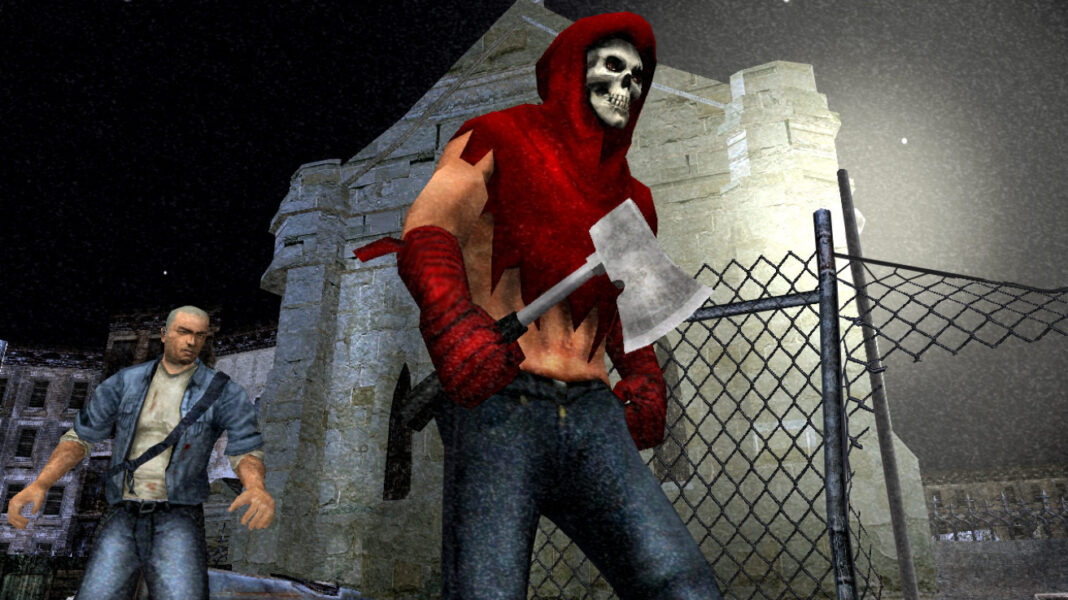
Things aren’t all that bright in Carcer City. Along with the uptick in violent crime and the general urban decay around every corner, this particular night will be one to remember. James Earl Cash (the player) is set to be executed after a lengthy stint on death row. However, after the deed is seemingly done, Cash awakens in a dimly lit room to the sound of a voice in a freshly installed earpiece. The voice is only known as “The Director,” and in exchange for your unexpected freedom from the penal system, you’ll just have to do one thing for it: kill. As you’re ferried around Carcer City by The Director’s band of private security goons, you’re forced into committing acts of wanton violence against thugs, murderers, and psychopaths, all under the watchful eye of CCTV cameras. Meanwhile, an investigative journalist attempts to piece this destruction together with a recognizable culprit.
For something that came out in 2003, this was pretty intense. The idea of a playable snuff film hearkens back to the days when something like Night Trap rocked the media landscape for its creepily candid presentation. At least in Night Trap, the main goal was to save a group of teenage girls instead of slaughtering them in the most purposefully brutal way possible.
Manhunt is a game about one thing, and one thing only: brutality. Sure, the violence itself is fairly tame compared to what would come in the decades since — or even the standalone follow-up that would release just a few years later — but it really seemed to rub a few people the wrong way. This even extended to the developers at Rockstar themselves. Matt Cundy of Gamesradar+ reported on a blog post by former Rockstar employee Jeff Williams, which went into some greater detail on Manhunt‘s volatility within the company. Per Williams:
“. . . there was almost a mutiny at the company over that game. It was Rockstar North’s pet project — most of us at Rockstar Games wanted no part of it. We’d already weathered plenty of controversy over GTA3 and Vice City — we were no strangers to it — but Manhunt felt different . . . It was all about the violence, and it was realistic violence. We all knew there was no way we could explain away that game. There was no way to rationalize it. We were crossing a line.”
Concerns weren’t just limited to worried parents and tasteful developers, either. Noted politicians and activists like Joe Baca and Jack Thompson, respectively, each outright decried Manhunt for its perverse presentation of video game violence, citing the usual “think of the children” and other moral platitudes that were used against Rockstar’s other controversial games. It earned some additional notoriety for its presence in an upsetting murder case, as reported in Daily Mail, with its looming sequel only stirring the proverbial pot even more. Thompson, an attorney at the time, would even pursue multiple legal battles against not only Manhunt, but several of Rockstar’s other games up until his disbarment in 2008.
RELATED: ‘Postal’: Looking Back at the Controversially Raunchy Game Franchise
Seeing what games are capable of depicting now, though, makes all the squabbling over Manhunt‘s content feel a bit overblown. I had a small discussion with a friend of mine about Manhunt recently, and naturally, its violence ultimately came into play. I had wondered why Manhunt made such a hullabaloo back then when, in The Last of Us Part II nowadays, you can callously kill a vicious dog by smashing its skull with a pickaxe. Then you can listen to its owner weep and wail as they discover its freshly mangled corpse. Am I exaggerating? Not by much, honestly. Adam Rosenberg of Mashable even put his thoughts about a similar scenario in a spoiler-free article. That’s to say nothing of how human foes similarly weep and wail as you either slash throats or shoot heads without a second thought.
But my friend mentioned something that I really think made Manhunt so shocking for the time: context. A major publisher pushing out what amounted to a playable snuff film, something that only exists in urban legends for most, compared to a brutal post-apocalypse where violence and revenge go hand in hand with each other, would certainly push the envelope. Combine that with your choice in targets — paramilitary goons, corpulent white supremacists, Latino satanists, grotesque predators, and escaped inmates — and the arcade-y approach in how you make progress, and you can certainly see how Manhunt rattled a lot of perturbed parties.
Doorway Into Hell

Speaking of which, playing Manhunt itself is less of an exercise in ultraviolence and more like a game of bloody hide-and-seek. Mostly.
Manhunt is a stealth game, for the most part. Cash is outgunned, outmanned, and ill-equipped, and given that he’s usually dumped into a random area of Carcer City that’s swarming with a variety of colorful murderers, staying on the down-low is usually in his best interest. You have the typical qualities of the stealth genre here — moving quickly or fist-fighting your enemies generates a lot of noise, stick to the shadows and move slowly to avoid detection, make distractions to tear enemies away from their patrol paths, and so on. Cash isn’t necessarily a weakling, but he’ll go down pretty quickly if he’s surrounded, especially if he’s being riddled by constant gunfire.
Thus, you enter the primary loop of Manhunt. Hide in the shadows, isolate someone from their patrol, creep up behind them, and take them out. Stealth kills — or “executions” — are split into three different categories across a handful of different weapon types, with each category being based on how long you ready your weapon before going in for the kill. Hasty executions are the quickest, focusing more on just dispatching whatever is in front of you. Violent executions are much harsher, but still don’t quite satisfy that carnal desire for bloodshed. Gruesome executions take the longest to set up, but are the most viscerally satisfying to pull off, often resulting in additional gore or a drawn-out animation that vastly exceeds the previous categories. They also grant the most points compared to the previous two.
RELATED: ‘Bloodrayne 2’ at 20: Revisiting the Bloodthirsty Bombshell
Manhunt has a grading system, believe it or not. Across the game’s 20 different “scenes,” or levels, you’ll be able to earn up to five stars for your performance in each of them. One star is for beating the time limit for a scene, one star is for playing well on the game’s Hardcore difficulty (more on that later), and the other three are assigned to your overall brutality. You’re not gated from seeing the rest of the game if you don’t get a perfect score, but you do get some fun goodies for performing well. Aside from unlocking concept art for every scene you get three stars in, you can also unlock a total of four different additional scenes that have their own unique challenges. Because of this, Manhunt weirdly has more in common with a classic survival horror game than something like Hatred. Planning out your route and learning the ins and outs of every scene is more important than just playing out a violent fantasy.
This is doubly true for how you handle melee weapons. As mentioned, they come in several categories:
- Green weapons, which are silent but can only be used once before being discarded.
- Blue weapons, which can be used multiple times at the cost of generating a bit of noise per execution.
- Red weapons, which are the most effective in combat but also produce an incredibly loud noise.
You’re free to swap between them at your own leisure. You’ll also need them to pass context-sensitive areas for progression, like using a crowbar to break a locked door, or using a shard of glass to cut a tightly knotted rope. Yellow weapons are also available, though they’re just projectiles you can throw to cause a distraction or temporarily stun an aggravated foe.
With all this in mind, you’d think the formula for an effective stealth game would be firmly established. You’d be right. That is, until guns get involved.

Guns, at least to me, give Manhunt a bit of a unique identity. They represent a significant escalation in threat. No longer can you brazenly sprint past your foes, duck into the shadows, and then safely walk around in broad moonlight once they turn their backs. Now you can be attacked from a distance. Towards the end of the game, even stepping out into the light means you’ll likely be gunned down by machine gun fire in as little as two seconds. Even snipers will be on your tail if you cause too much of a ruckus in their vicinity.
Though guns are a rarity in the early game, making their use feel like a special, defining event, there comes a point where entire scenes are seemingly devoted to just ducking behind cover, popping out to explode heads, and repeating until the cameras shut off. It’s certainly snappy — enemies are fairly aggressive and accurate, and your weapons suffer from significant damage falloff at longer ranges. I even died quite a few times during some particularly tense sections.
It’s just . . . weird, it’s not as if it’s an ineffectual system, but it’s just such a stark contrast compared to what you’ve been doing for hours beforehand. View of Innocence, a scene that introduces you to the appropriately named Innocentz, kicks this kind of playstyle off, with the game only ever retreating from it in a few errant scenarios.
RELATED: ‘Butcher’s Creek’ Review: Condemned Meets Cosmic Horror
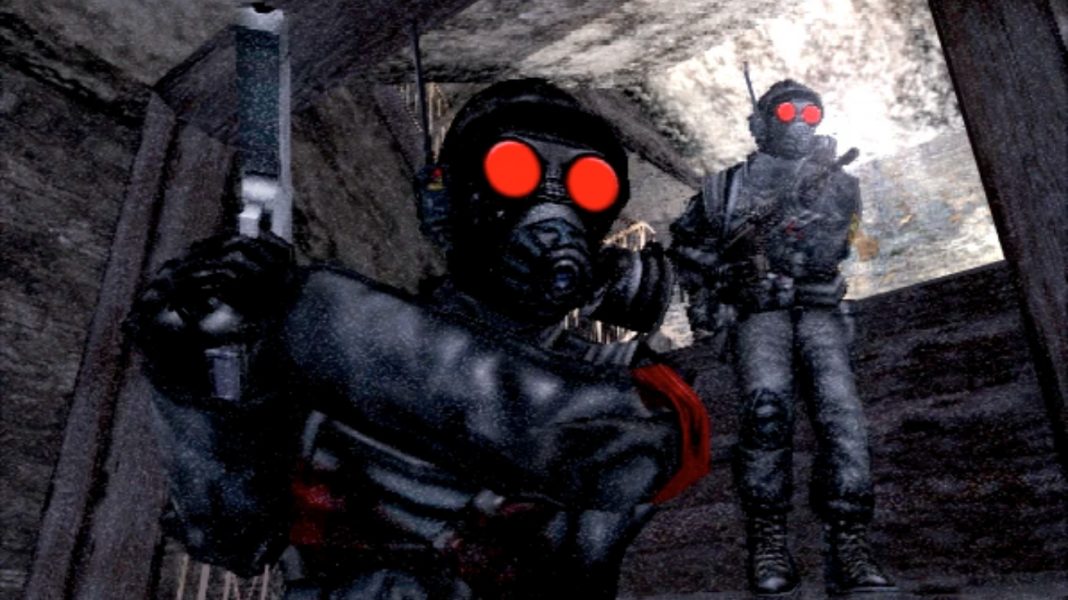
The final few scenes, where Cash is hunted by the Carcer City Police Department as well as the enigmatic militia under The Director’s employ, really stretch this strange mix of stealth and lightning-fast gun battles as far as it can possibly go. So much as a single mistake will be your undoing. Because of this, it’s not uncommon to pop a guy’s head, find somewhere to skedaddle to, and semi-comfortably gun down a tidal wave of heavily armed foes as they trickle towards your position. This isn’t foolproof, mind you, and Hardcore mode really throws a wrench into this specific approach. But the later scenes are definitely something that you’ll have to acclimate to instead of relying on your past experiences.
Hardcore mode deserves a quick mention. Likely the ideal way to play given its ability to net you five stars, Hardcore makes an already challenging game all that more difficult. Your foes deal more damage, they’re more accurate, and they can spot you far more easily. But what’s most interesting about Hardcore is that it outright removes your minimap, forcing you to rely on nothing more than your vision, hearing, and prior scene knowledge to gauge any nearby enemies. It’s certainly a step up in challenge if you felt that the ordinary gameplay loop was a little too simple.
The Horror of Manhunt
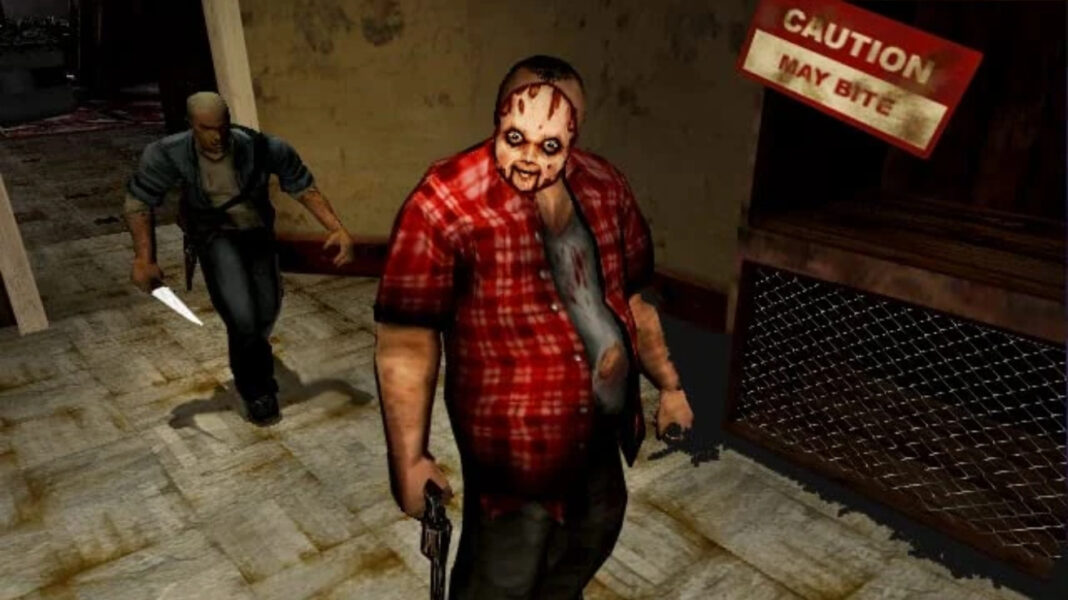
It’d be a shame to spend all this time talking about Manhunt without mentioning its presentation. Unlike its 2007 follow-up, which dove headfirst into gory pulp and over-the-top concepts, Manhunt maintains a somewhat believable edge when it comes to its numerous gangs, its dangerous alleyways, and its overall level of carnage. It’s uncomfortable, but not to the point of fully divorcing itself from reality.
Take the gangs, for example. There’s a clear escalation when it comes to the grimy, foul language-spewing foes you’ll be stalking in the shadows. You start out with the Hoods, nothing more than a gang of loosely connected street thugs that still look like you or me. From there, you get to the Skinz, a stereotypical group of Neo Nazis donning Confederate flags and hockey masks within the rusted remains of junkyards and municipal waste facilities. Meanwhile, the Wardogs and Innocentz — militia members in military fatigues and an eclectic mix of Satanists and sexual deviants, respectively — make their homes in the abandoned structures of Carcer City, inhabiting zoos, malls, and other complexes that suit their more elaborate operations. Then you get to the Smileys, which are escaped asylum patients that feature vivid yellow masks adorned with busted smiles and pleas for help.
Combined with the dark lighting, the frequent use of VHS filters and CCTV cameras, and a dynamic synth score by Craig Conner, you have what feels like one of those incredibly grungy, effects-driven horror flicks from the 1980s. Think something along the lines of John Carpenter, or maybe something like Intruder or Evil Dead Trap.
RELATED: Revisiting ‘Total Overdose’: Max Payne Meets the Mexico Trilogy
It’s the kind of atmosphere that’s thoroughly drenched in irreverence and exploitative sleaze, leaving the same kind of gaping feeling in my gut that I felt while watching William Lustig’s Maniac. The terror itself isn’t necessarily the showcase, but the misery surrounding it is. No spoilers for either Maniac or Manhunt, obviously, but both Cash and Maniac’s Frank Zito find themselves in a Hell of their own making, with violent murders bookended by their own vehicles of suffering. But, whereas Maniac attempts to provide some insight into Zito’s desire for killing, and even the emotionally charged aftermaths of his hunts, Manhunt instead veers into revenge territory once The Director gets Cash’s family involved.
You can even find a slasher villain in the form of Piggsy, the single most enduring entity in the entirety of the Manhunt franchise. An obese serial killer wearing nothing but a bloody pig mask, Piggsy is gradually teased throughout most of the main journey before becoming a fully-fledged performer in The Director’s game himself, culminating in the most memorable sequence outside of the numerous executions you can perform. I can’t say much more than that, but it’s definitely something that’ll linger with you long after the credits roll.
Should You Play Manhunt?
Maybe? It’s hard to say, actually. Manhunt certainly appeals to the kind of horror fan that wants to act out one of the same grungy slashers I mentioned previously. There’s an appeal for more arcade-oriented players who want to conquer each of the game’s numerous scenes. The later scenes are definitely polarizing, but some intuition and dedication to seeing things through will carry you to the end.
There was certainly a dirty feeling that accompanied Manhunt, though, at least throughout its first few scenes. Rockstar Games had defined itself by pushing boundaries wherever it could. While they would continue that trend with games like Bully and even Grand Theft Auto IV, you could argue that Manhunt was the first time they really flew too close to the sun.
Manhunt 2, in an attempt to up the ante, was famously given the dreaded Adults Only rating by the ESRB due to its even more extreme bouts of violence, prompting a fresh media circus, outright bans in several countries, and a butchered retail release that censored a majority of its core content. In short, it was given the same treatment that 2005’s The Punisher got, albeit far worse. But that’s a story for another day. Suffice to say, because of the mess it made, it’s not really in anyone’s financial interest at the moment to revive this long-dormant series, especially with the success of Grand Theft Auto V and the soon-to-be-released Grand Theft Auto VI on the way.
RELATED: ‘Slitterhead’ Game Review: A Strong Debut for Keiichiro Toyama’s New Studio
Still, unlike Manhunt 2, which seemingly disappeared into the legally grey ether, Manhunt is still around. As a matter of fact, it’s been available for digital purchase for years, even getting a rerelease on PlayStation 4 as recently as 2016. Combine that with some not-so-subtle references to the series strewn throughout Grand Theft Auto Online, and you certainly get the impression that Rockstar still somewhat cares about Manhunt to some extent.
Ultimately, I would recommend Manhunt to any horror fan, or even fans of Rockstar’s earlier games in general. It’s an interesting foray into an unfamiliar genre for Rockstar, one that’s as deliciously inspired as it is delightfully gory. Seeing as how its influence can be felt in modern games like Butcher’s Creek, it’s worth seeing how it managed to dominate controversial discourse for the better part of a few years.
Manhunt is available on Steam (though you’ll need to heavily mod it in order for it to work as intended), as well as being available in a digital format through PlayStation and Xbox.
We’re hardworking geeks that love to geek out, but we can’t do it without you! If you enjoyed this article and want to see more like it, please consider tipping our writers. Also, as an Amazon Associate, we earn from qualifying purchases.