


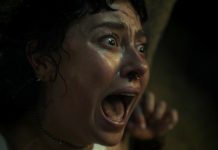


My husband won’t go camping with me. He’s a pretty outdoorsy guy. We spend a lot of time in nature, hiking and trail running, going to the beach. The more secluded the better. Camping seems right up our tree-laden alley, surrounded by nature and woodland creatures, building a fire, sharing marshmallows and ghost stories. But I ask, time and time again, if we could go camping, and he will not do it. He has a few excuses for why he won’t go camping with his persistent, stubborn wife, but the main reason, the most consistent reason, is because of a girl named Heather Donahue…and the way she screamed.
My husband was 13 years old when he saw The Blair Witch Project in theaters, and the newly minted website IMDB.com listed documentarian/star of the film, Heather Donahue, as “missing, presumed dead.” The same epithet accompanied actors (or, at the time, “crew members”) Michael Williams and Joshua Leonard. There was no way to know otherwise. This was the late nineties, and the boom of the internet wasn’t quite the mushroom cloud it is today. That isn’t to say it wasn’t rapidly growing, year by year, new sites, uses, and connectivity sprouted from the cyberforest. The first film to ever have a promotional webpage was Stargate in 1994 (check out the archived page here). So, when a webpage devoted to the pursuit of piecing together the Burkittsville missing kids mystery hit the internet, it gained the morbid attraction of websurfers who, by way of email and instant messaging, shared the site and, consequently, interest in the film. This practice would soon come to be known as “going viral.”
Related Article: Interview: Eduardo Sanchez, Director of The Blair Witch Project
When the film hit the festival circuit, the already widely embraced VHS bootleg culture saw it popping up in small homes across the country, adding to its cult appeal. When it was accepted into Sundance, the town was papered with Missing Persons flyers leading to a packed house at its midnight showing, and it delivered. Artisan Entertainment bought it to the tune of $1.1 million, and the phenomenon grew national.
Shot on CP-16 and Hi8 cameras and released in academy ratio, The Blair Witch Project tells the story of three film students who investigate the legend of the Blair Witch in the small town of Burkittsville, Maryland. Formerly the town of Blare, residents share stories of the witch – an unsettling depiction of local folklore mixed with the horrific account of a 1940 mass child murderer, Rustin Parr, who claimed to be under the witch’s thrall. The trio trek into the Black Hills forest, and soon after become lost, scared, and terrorized by sounds in the night. Effigies hang eerily from the trees, and Heather, Josh, and Mike deteriorate as the reality of their horror sets in. In true documentary fashion, scenes vacillate between emotionally charged shouting matches and vague, quiet moments of unresolve. Things charge to a spinning, Lovecraftian climax in which Heather’s fear crescendos in surrounding chaos before blackout.
And supposedly a year later, the footage was found, coining the term “found footage.”
Related Article: ‘The Blair Witch Project’ is not a Movie – It was an Experience.
In 2007, eight years after the release of The Blair Witch Project, 12 found footage films were released. Between 1980 and 2007, 22 found footage films were released. That amounts to a 14% increase in one year. And much like a wound that won’t stop bleeding, found footage films have saturated modern cinema with multiple releases every year, normalizing the style as a bonafide subgenre of the horror industry. And that’s what makes this film so special. It’s a kind of special a first-time viewer growing up post-millenium will never be able to understand or appreciate. Saturation leads to desentization, after all. This kind of special comes from the marketing and production that did what very few horror films ever accomplish: it completely and indefinitely suspended our disbelief.
A small number of horror films have been able to capture the fiction as truth in such a momentous way, and it’s unlikely we’ll ever see it again. In the 1970s, a trend of “inspired by true events” and guerilla, documentary style dominated the horror cinema landscape. The foundations laid by The Legend of Boggy Creek (1972), Last House on the Left (1972), The Texas Chainsaw Massacre (1974), and Cannibal Holocaust (1980) paved the road for The Blair Witch Project. It wasn’t something that hadn’t been done before, but it was something that captured the sign of its times, wrapped it up in twine, and cast a spell on the world.
Eduardo Sanchez and Daniel Myrick, the minds behind the project, had a keen sense for what needed to be done to make the film as authentic as possible. Dropping Heather, Mike, and Josh in the woods with two cameras, a GPS, and walkie talkies to communicate with the filmmakers, Sanchez and Myrick watched the dailies each night and soon saw the narrative come together. They left rations and small notes for the actors, but had little contact with them other than making things go bump in the night. As producer Greg Hale said, “Your safety is our issue, your comfort is not.” The authenticity of the actors plight is happening in real time. There were no rehearsals and very few retakes: as the audience experiences each new event, the actors experience it for the first time too. It’s a taped recording of a live performance: improvised, impenetrable, and stirring.
It’s been twenty years since The Blair Witch Project captivated audiences with its supernatural true crime story, grossing nearly $250 million worldwide on a $60,000 budget, and I have to wonder what audiences today would think if it was released now. It would be short order to find out that Heather, Josh, and Mike weren’t dead or missing. The “everything you’ve heard is true,” tagline would be a laughable search engine away from disspellment. The SciFi Channel exclusive The Curse of the Blair Witch, which featured the unused interview segments Sanchez and Myrick cut from the original release, would feel like an episode of Ancient Aliens. I would think it would fall into obscurity, with common criticisms of “never seeing the monster” and “shaky cam” dismissing it as a mediocre, somewhat nauseating, found footage flop. Or, even worse, Artisan Entertainment would go with its original plan to remake the film with A-list actors (yes, that was the original plan after they purchased the rights at Sundance), casually dismissing that what makes the film so powerful is its raw, anxiety-addled cast.
I also don’t think this kind of speculation is fair. The film is a product of its time, and damn if it doesn’t hold up as a fantastic horror film, much like it’s 1970s predecessors.
It’s charming and real, painting the portrait of three aspiring filmmakers dropped into an unpredictable situation. It frames the trauma with real world agitation, and escalates it with foreboding, unexplainable circumstance. It’s reactionary, not just to 1999 but to the beats that push the narrative forward. What I mean is: it still feels real twenty years later. Because it is real, and it was real. It’s kind of like professional wrestling…sure we know it’s choreographed with a story laid out in advance, but that doesn’t mean the bumps don’t hurt. That doesn’t mean concussions, broken bones, and torn ligaments don’t happen. It doesn’t make it any less enjoyable to watch. To quote a famous viral video, “It’s still real to me.” And it’s still real for my husband, who won’t go camping twenty years later because of Heather Donahue and the way she screamed.
If it’s still real to you, too, check out The Blair Witch Experience, a non-profit, fan led annual camping trip and tour of the film sites used in The Blair Witch Project. The 4th annual trip takes place October 18th-20th, 2019. The author is still trying to convince her husband to go.
Related Article: 5 Found Footage Films That Deserve More Credit