



“Meta” has become a buzzword in horror ever since Scream hit theatres in 1996. It’s now seen as the grand-daddy of meta-slashers, a self-referential valentine to a genre whose tradition has carried over into four sequels. It’s also brought with it a fair share of deconstructionist horror satires, including Tucker and Dale vs. Evil (2011), Cabin in the Woods (2011), and Final Girls (2015)—all flicks that entail a cast that’s pretty much aware they are in a horror film.
What once was a novel send-up of those cliches that saturated the ‘80s has become its own subgenre. In 2022, it may seem mundane to revel in the tropes and cliches of the slasher film (as mundane as rehashing the tropes themselves), but 15 years ago, there was a predecessor to the early 2010s meta-horror movement that stands as the ultimate totem of horror satire.
Behind the Mask: The Rise of Leslie Vernon flew under the radar in 2007—admittedly, it almost flew under mine until a fellow film student pulled me aside at a party and asked if I had seen it. Deep in the analytical analysis of Caroline Clover and David Bordwell, I was immediately intrigued. After viewing it, I was a little flabbergasted: Why had I not heard of this film before? What theatres did it play? How had I missed the buzz on this?
And there was buzz. At every festival it played, Behind the Mask: The Rise of Leslie Vernon received rave reviews, even earning it the Audience Choice award for Best Feature at the Toronto After Dark Film Festival, amongst other awards along the way. But Anchor Bay released it to less than 80 theatres nationwide, and after its short run, earning it about $70k nationally, it went straight to DVD.
According to the film’s director, Scott Glosserman, it was released in markets just for the reviews to get buzz quotes for the DVD box as what he called a “dirty little secret” of the film industry. Anchor Bay never had any intention of a national release, and it’s a damn shame because Behind the Mask: The Rise of Leslie Vernon is probably the smartest meta-horror ever made.
As a lifelong horror fan, there’s always been an understanding that we’re the misfits, the weirdos, the othered of fandom. And yet, we have a grand tradition of community. We are not an exclusive ilk. We do not shy away from sharing our passion and gladly open our bat wings to embrace new lovers of the genre. Even the makers of horror films have this collectivism: from Mick Garris’s Masters of Horror Dinners to the sheer volume of anthology creators whose sole purpose is to bring talent together on a single project.
The collaborative spirit was on display on the set of Behind the Mask: The Rise of Leslie Vernon, as Angela Goethals-soder (Taylor Gentry) told HGL, “…we had an unspoken agreement to collaborate at the highest level, a group of artists/filmmakers who were excited about the work, who friggin’ LOVE what they do; we had actors who are brave and curious and kind. And, we had a certain rogue spirit and fearlessness within the process.”
What I’m saying is that Behind the Mask is a horror film for the shared spirit of horror fans and filmmakers alike. Because it understands why horror (particularly slashers) work and doesn’t talk down to us. It’s a love letter that doesn’t belittle us for our tropes and cliches. It celebrates them, usurps them, and it’s a curiously heartwarming display of the nuances of horror itself.
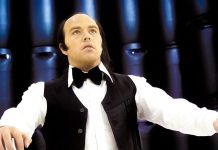
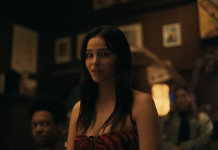
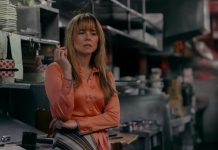
In a world where Freddy, Jason, and Michael are real, Taylor Gentry (Angela Goethals) is making a documentary about one man’s pursuit to become the next great slasher icon. Her subject is Leslie Vernon, a charming, up-and-coming slasher with a seemingly sordid past whose training and preparation are meticulously documented by the crew leading up to his big night. As the event draws closer, Taylor and crew realize they cannot remain objective when lives are on the line, and the point-of-view changes from documentary to straight slasher when bodies start hitting the floor.
The central theme hinges on Vernon’s relationship to those who came before: the big slashers are not filmic portrayals (no ‘the movies made me do it’ Scream rip-off here) but real, flesh-and-blood, true crime killers treated as industry professionals with clout and a code of ethics.
There’s a community in the killers and an understanding that the “business of fear” is a necessary aspect of life. Evil has to exist for the sake of the good. This is best displayed by Eugene, a retired soldier of the slasher army, played by character great Scott Wilson, who himself is an homage to Billy in 1976’s Black Christmas.
RELATED: ‘The Cabin In The Woods’ Is Still Meta-Horror Insanity
Eugene explains to us (via audience stand-in Taylor) the history and legacy of the “fear business” and how things changed from the ‘60s and ‘70s to the ‘80s mega-slashers. Eugene has settled down with his final girl, Jamie (something akin to Sally Hardesty settling into a nice Texas homelife with Leatherface). He displays a fatherly devotion to seeing Leslie succeed in becoming his own slasher icon. Some of the most endearing character moments come from Leslie’s relationship with Eugene. You almost forget this is a man who is premeditating mass murder – which is exactly what Taylor and the audience do.
The beauty of Behind the Mask is how it creates a voyeuristic exploration of the horror genre. It’s an exercise in desensitizing the audience to the horrific outcomes of Leslie’s plan, dehumanizing the actual victims as we spend most of the runtime with Leslie. We empathize with his murderous goals instead of the survival of the victims, satirizing the move of slasher films from creating fleshed-out characters who we root for to rooting for the slasher himself. The victims are soulless marks whose only purpose is cannon fodder.
There are the little homages as well. At Eugene’s driveway, the car is the same as Sam Raimi’s beloved 1973 Oldsmobile Delta ‘88. In Eugene’s house, a Lament Configuration cube. Leslie’s pet turtles are named Church and Zoey – expectantly after Church the Cat and Zoey the Dog from Pet Sematary I & II. At a high school, three girls in white dresses skip rope, ala A Nightmare on Elm Street. Not to mention, there is the icon Robert Englund playing against-type as a Dr. Loomis-style Ahab to Leslie’s wannabe Michael Myers. Even Kane Hodder has a “blink, and you’ll miss it” moment as “Guy at Elm Street House.”
While it plays into the cliches, Behind the Mask is also mindful of how complex a horror film really is. From underpinning Leslie’s goal with symbolic details of yonic and phallic representation (a send-up of scholarly analysis of the horror genre) to creating the laughable cardio routine a slasher must abide to walk when everyone else is “running their asses off,” it celebrates the craft from the angle of a minor league baseball player trying to make the majors.
Taylor’s devotion to her documentarian objectivity gives us the lens to view these tropes as a planned objective. For most of the narrative, she’s a journalist, documenting without intervening and getting a deep, behind-the-scenes account of how the scares—what in a normal slasher film would be a cliche—are actually “rules of the industry.” It plays as a how-to guide of survival that is winningly usurped in the final act (that I will not give away here).
We’ve also spent time with her. We care about her and her relationship with Leslie, and that’s why, when the subversion happens, she enters the story as the final girl we can root for.
Instead of being unoriginal or unpredictable, Behind the Mask highlights that tropes are necessary for all genres. The tropes make the movie. It’s the same reason I don’t mind spoilers: it’s not the content that matters. It’s the execution. As Leslie points out, it’s the personal touches that make a masterpiece. It’s why Behind the Mask is the truest horror satire to date: it loves, respects, and builds the genre while calling it to task. It understands the collective spirit of horror fandom. And it represents that question that every horror viewer contemplates: if I were in a world of slashers…
Sequel buzz has clamored on and off for years, given the end credits tease of more Leslie Vernon. After the DVD release and despite the cult love of the film, studios just weren’t biting.
“I think the real issue was, at the end of the day, we kind of missed our window,” Glosserman told Bloody Disgusting in 2021, speaking about the difficulties he and Stieve had in starting a franchise. They had a script ready by 2009, with Englund championing the continuation and bringing other genre icons into the fold. But the subsequent rise and fall of meta-horror in the early 2010s crushed any potential for a studio to be interested.
In 2012, Scott Glosserman and writer David J. Stieve started a crowdfunding campaign to get a sequel off the ground, but it fell short of its goal (not because the idea wasn’t beloved but arguably because crowdfunding was still in its earliest days of conception). In 2017, IndieGoGo successfully funded the 8-part comic series Before the Mask: The Return of Leslie Vernon, which takes Stieve and Glosserman’s original ideas for the 2009 sequel and faithfully adapts their story for the graphic novel page.
But that doesn’t mean a new script can’t be done.
With the rise of slasher reboots and legacy characters, perhaps now is the time to strike for a Leslie Revival. And despite his retirement from acting, Nathan Baesel has told this HGL writer, “The only thing that might bust me out of retirement is a BTM sequel.”
A sequel wouldn’t work without Baesel, whose endearing charm mixes wildly well with Leslie’s terrifying psyche, cementing him as forever Leslie Vernon in many of our horror-loving hearts. For now, Baesel is teaching acting in the L.A. area and has shared that anyone serious about acting can message him on social media to find out more.
And, of course, a sequel wouldn’t be complete without Angela Goethels-soder’s Taylor. Prior to Behind the Mask, Angela had “never done a horror movie. Never watched many, either, as I’m a big scaredy-cat. On the page, you look at this script and are immediately drawn into this beautifully charismatic psycho (Leslie Vernon) and the relative safety of the “interview.” It feels manageable. Then you read things about screams and blood and dead bodies, and, as an actor, it’s like…HOW do I “go there??” How do I find that reality and live in it without falling over the edge into camp-y/silly?”
The split role of audience stand-in and final girl gives Taylor so much pathos we truly connect her to Leslie and it’s thanks to Goethals-soder portrayal of this duality that we come back to Behind the Mask again and again. It’s not just Leslie Vernon’s story, but Taylor’s as well. In a sequel, Taylor could come back either as an Ahab herself or as a potential Jamie-type, having reconciled her feelings about that night and now become a friend or paramour for Leslie (given their relationship prior to that fateful night, it’s could happen!). When asked about returning, Goethals-soder told HGL, “So. F*cking. In.”
I see it now…A team of YouTubers is doing a “Where are they now?” slasher series documenting Leslie’s retirement from “slashing.” He teaches a school for gifted youngsters who want to be the next great slasher (a nod and homage to Eugene’s mentorship), but Leslie’s disenchanted with teaching because no one wants a “new slasher.” Mike’s back in Haddonfield and Chucky’s in Hackensack, there’s no room for new blood. As the story progresses, we see him wonder why he shouldn’t Leslie be back in Glen Echo. And, well…you see where I’m going here…
Sounds like it’s time to put in a call to Stieve and Glosserman’s people.