









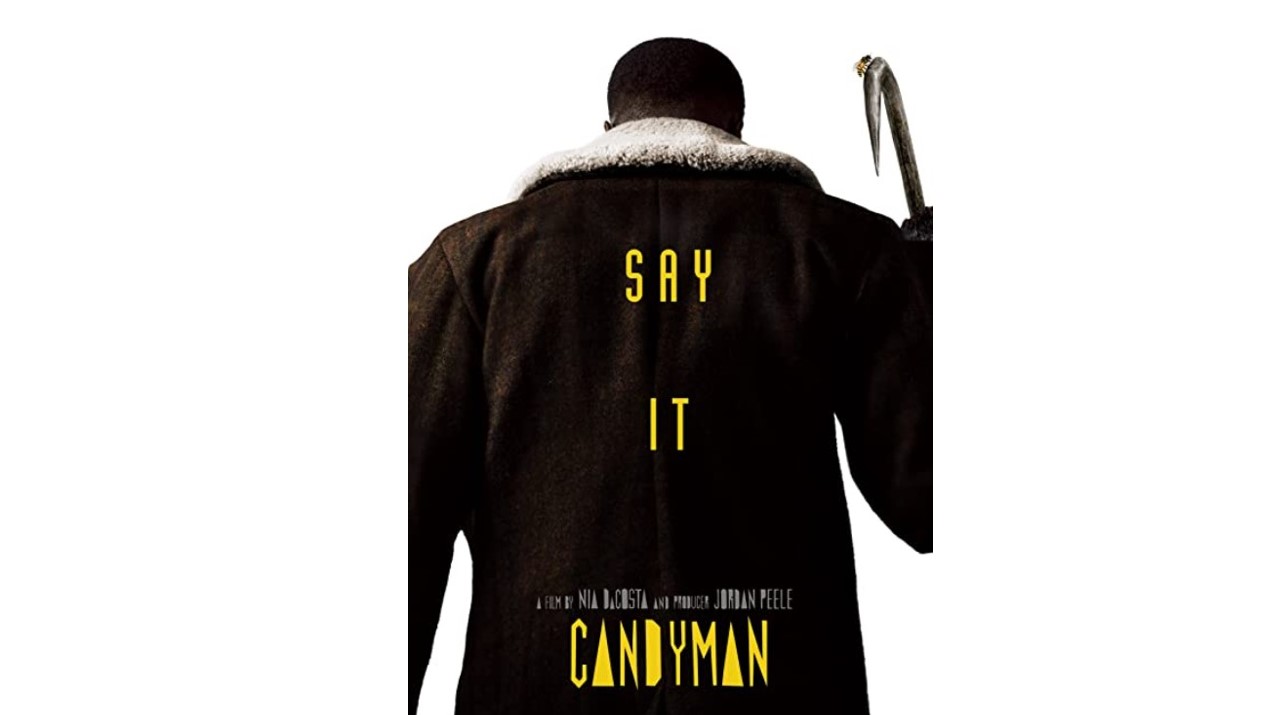
After initially being slated for a 2020 spooky season release and getting massively delayed due to Covid-19, Nia DaCosta’s Candyman finally hit the big screen, becoming the first film directed by a Black woman to hit number one at the box office. There have been a ton of questions surrounding the newest installment of the franchise. Is this a sequel or a remake? Will Tony Todd reprise his iconic role? Would Virginia Madsen make an appearance as the ghost of Helen Lyle? I had the chance to hit a late theater showing of Candyman, and Nia DaCosta took all my expectations, and threw them out the window.
Starting with the plot, the film takes place in the present-day Cabrini Green area of Chicago, the same area from the original film, but now gentrified to the max. Anthony McCoy (Yahya Abdul-Mateen II) is a struggling visual artist seeking the balance of finding inspiration for his art and making a name for himself without riding the coattails of his successful artist girlfriend Brianna (Teyonah Parris). After a night of dinner and drinks, Brianna’s brother Troy (Nathan Stewart-Jarrett) tells them the story of the Helen Lyles murders and abduction of a baby, 30 years prior in the area. The story prompts Anthony to go digging for artistic inspiration, and he learns the story of Sherman Fields, a hook-handed Black man who was accused of putting razorblades in a white girl’s candy and then beaten to death when the police found him. Inspired by the story and the legend of Candyman, Anthony creates an art exhibit, spreading the classic myth once again. As people start to say his name and are viciously murdered, Anthony undergoes changes to his physical and mental being, all while learning new developments about his past.
Support this awesome writer — 100% goes directly to them!
 Feed My Coffee Addiction
If my plot description didn’t answer it for you, this film is a direct sequel of the 1992 Candyman film and ignores the events of its two sequels. References are made to many characters from the first film, and its entire story is a starting point basis for this film. A major change for this film, was that Nia DaCosta used the story of Sherman Fields rather than Daniel Robitaille’s (Tony Todd) to set up a more modern version of the overarching tale. I loved this move, as it’s intention is to show the audience that these stories of racial injustice aren’t something that only happened in the late 1800’s. These are stories that, unfortunately, still happen in the Black community every single day. Honestly, the same exact story is being told, just in a different way. It’s not about one Candyman. It’s about the same thing happening over and over again, and nothing being done about it. Major props to DaCosta for this choice, though it may hit some fans of the franchise differently, but this is her way of saying his name and keeping the legend going.
The overall acting was extremely strong. Anthony’s transformation and descent into madness was intense and bothersome to watch. I wish a few of the other characters were better developed, as I feel like they got lost in the story building. The film did capture some of the classic Candyman magic by having the audience to root for the deaths of annoying and pretentious victims, but I found myself wanting more emotion and depth from several of the main characters. The story was serious, and I wanted to feel for more characters than just Anthony.
RELATED: Ghosts, History, & Stephen King: Experiencing the Stanley Hotel
Like Philip Glass’s score in the original film, Robert Aiki Aubrey Lowe’s score for this film is absolutely masterful. Lowe used manipulated insect sounds, created choirs of his own voice to connect with sounds of West African ancestors, and even entered old, abandoned houses in Cabrini Green, recording the sounds of the wind hitting their empty walls. Much like the John Carpenter’s Halloween theme, or John Williams Jaws, the score for this film is very much just as iconic as its characters.
The effects of the film were a bit of mixed bag. The makeup and costume design were wonderful. There were body horror moments that were downright disgusting and made me wince. Unfortunately, some of the CG felt unpolished and clashed against DaCosta’s beautiful, stylized shots, causing more of a distraction rather than adding to the moments. Some of the choices made during kills were confusing as well. For example, when Candyman was slicing and dicing, some scenes were done where he isn’t visible at all, creating sillier yet similar scenes to some Nightmare on Elm Street films. Other scenes seemed like they were going to focus on the brutality of the kills, but cut away, showing the viewpoints of people not watching. I understand that a lot of the horror comes from the story, but I also feel that if you’re continuing the story of a brutal, gothic slasher film, showing the slashing scenes can do a lot for your audience.
RELATED: Trailer: Mike Flanagan’s Horror Series ‘Midnight Mass’ Hits Netflix This Fall
Conversely, the shadow puppet effects used for telling history and backstory in this film were fantastic. I am an absolute sucker for artistic scenes like this. I’ve seen similar scenes in films like Harry Potters and the Deathly Hallows, Krampus, and Impetigore and I love it each and every time. Breaking away from a film to do this pulls the audience close and intimate, like they’re being told a ghost story around a fire. Specifically for this film, showing backstory this way still gets the idea across in a colorful and resonating way, without the visceral visuals of brutalizing Black people on screen.
Overall, I left the film incredibly satisfied. The horror fan in me went into it with expectations of seeing a remake of the same film, with the same characters, and at first, that part of me felt a little disappointed when it didn’t turn out that way. However, this film is so much more than just a sequel, and I appreciate its depth and DaCosta’s vision in a way I never imagined. Now it’s my job to do exactly what the film’s message demands I do…Tell Everyone.
RELATED: Book Review: ‘My Heart is a Chainsaw’ is an Emotional, Jaw-Dropping Slasher