








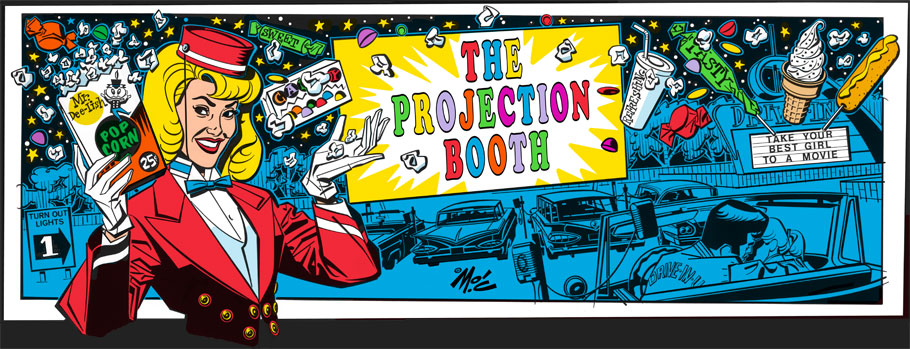
The Projection Booth Podcast has been entertaining film fans for twelve years now. It has a unique format in which the hosts will discuss a particular film in depth while also incorporating interviews with filmmakers, actors, authors, or anyone who can give a unique perspective or insight into it. Co-founded and hosted by Mike White (not that Mike White), the show has amassed over five hundred episodes, spin-offs, or special episodes while welcoming guests like John Water, Jeff Goldblum, William Friedkin, Joe Dante, and many more.
Mike is an author and journalist who founded the zine Cashiers du Cinemart in 1994 and has contributed to publications such as CinemaScope, Paracinema, Detroit’s Metro Times, and Detour-Mag.com. Based in Michigan, White has even found himself lending commentary to the Arrow Video release of The Thing (1982) and Shout! Factory’s Exorcist II: The Heretic (1977). In 2011, The Projection Booth Podcast was born, and from then on, his life would be consumed by making it the best it could be.
People don’t turn into film fanatics overnight, it almost always stems from childhood, and White’s experience was no different. “I grew up watching a lot of movies. It was an activity that my mom and I would do quite often, even allowing me to skip school so we could go together. It was just kind of like our thing. Then eventually, my friends and I weren’t in sports or drinking, so we would go to the local video store and rent movies. It kind of became like our thing. We would get into the Blaxploitation films or the Something Weird Video compilations. It was our social activity,” White remembers. The obsession didn’t end there.
When attending the University of Michigan, the obsession and appreciation would continue to grow. He continues, “When I went to college, I really was pretty aimless. I had no idea what I wanted to do, then one of my counselors ended up putting me into a film class, and it actually spoke to me. There were probably three or four different campus societies for film, so on the weekends, it was just an embarrassment of riches. I would go through the magazines in Ann Arbor and figure out what to see on the weekend. What double or triple feature? It really was a fantastic time.”
RELATED: Creator Spotlight: BookTuber Criminolly Brings the Best in “Crime, Pulp, Horror… That Kind of Thing”
Working in movie theaters and video stores would only cement White’s decision to find his way to film journalism somehow. There would be special moments in his life that would help him decide which path he would take. White explains, “Probably right after I graduated school, I found this Chinese grocery store at Eight Mile and Greenfield. I would go in there and just rent movie after movie after movie. They had all these Chinese video cassettes, and luckily, they were all subtitled. It was a fantastic way to get exposed to Hong Kong cinema.”
International films seem to have been a way for him to broaden his palette and, in a way, broaden the palette of those around him. “When I was working at the video store, they had a pretty good selection of Pedro Almodovar films. I remember sitting around watching all these Almodovar films with my housemates, straight white guys, just sitting around watching these Spanish queer films, and it was pretty cool. You know, nobody was casting judgment; they were so open and would continue to be. It didn’t matter how weird or fucked up the movies were. We watched things like Forbidden Zone (1980) and Yojimbo (1961), then eventually, they would reciprocate. It really helped to foster my interests,” he concludes.
As time passed, White would put his love of film in print when starting his zine, Cashiers du Cinemart, which he would work on for many years and spanned several issues before BearManor Media collected them in a book called Impossibly Funky: A Cashiers du Cinemart Collection, in 2010. Shortly after, the foundation of the podcast would begin to take shape. “A friend of mine, Mondo Justin, and I were driving down to a film festival in Indiana, and the subject of podcasts came up. He brought up the idea that we should start a podcast. He remembers the exact opposite, and me encouraging him. I wanted to do a podcast but not like what other people were doing,” White exclaims.
Just like that, the wheels would be in motion to bring out the first episode, and it couldn’t have gone any better. He goes on, “Justin was amazing when it came to finding interviews. From our very first episode, which was on The Stunt Man (1980), he lined up director Richard Rush and Steve Railsback. That kind of just raised the bar, so from here on out, we’ll try to get interviews whenever we possibly can, which was really tough when we’re just starting out with no reputation.”
From there, The Projection Booth Podcast would continue to grow along with the caliber of guests. If a major guest like Paul Thomas Anderson or Daniel Day-Lewis were unattainable, then they would go for an expert like a guy who wrote a book on Upton Sinclair to get the best possible understanding of the source material and the particular film in question, which was There Will Be Blood (2007). With White having an eclectic taste, covering films from all genres was much more interesting to him and his colleagues than limiting themselves to a particular genre. “I try my best to talk about movies I like. There’s only been a few times where it wasn’t a good film. I really tried to find good things about Battlefield Earth (2000), but I couldn’t do it. I’m always trying to find things that I enjoy, and now with our Patreon, people suggest movies for us, and that’s kind of cool. The whole process has been a learning exercise for me,” he proclaims.
Speaking of learning exercises, starting a podcast isn’t just about the content itself. Just as important is the technology involved in bringing it to life. This would prove to be a challenge in itself. White elaborates, “We didn’t really have a hosting company for the show, so we ended up just kind of doing a bit for ourselves. I took our files off of a server where we were keeping our original website. That was fairly rudimentary, but after a while, we had enough listeners the speed of the site slowed to a crawl.” The time to move and grow would now be upon them, and luckily, their reputation was known, and the perfect opportunity was just around the corner.
RELATED: David Cronenberg’s ‘Videodrome’ 40 Years Later: Long Live the New Flesh!
He says, “We needed to find someone to help us grow when this company reached out to me and wanted us on their network. It worked out great for us at a time we needed it. I would say just the lack of knowledge around the technology was tough. It took a lot of years, and I still think we could sound better, but we started to sound like a decent show.”
During White’s zine days, his first interview would be with cult film icon Bruce Campbell. After interviewing one of his idols, he was prepared to take on many popular guests, including the ones mentioned previously. With so much talent, who would be a favorite? White comes forth with an answer to that particular question which was, in a way, shocking, but also not. “We had Dolph Lundgren on to talk about Red Scorpion (1988). I couldn’t believe I was talking to him. We’ve talked to so many people, and I’ve enjoyed talking with many folks. But I always default back to Dolph Lundgren; it’s a name that everybody knows, right? When people like Peter Bogdanovich or Jeff Goldblum agreed to be interviewed, they just blew me away. I couldn’t believe I was talking to them. Sometimes I can’t believe I’m talking to someone, but my main goal is to just be prepared.”

White and the team can spend anywhere from twenty to forty hours researching each film and their guests to try and give them a unique and engaging experience. The research includes watching the movie being discussed, possibly reading books, searching interviews, listening to soundtracks, or anything else that could help make the episode the best it can be. Preparation is the key; with each episode, it’s apparent they always are. There’s something for everyone to listen to. This will always set The Projection Booth Podcast apart, and their commitment to excellence in film discussion is truly inspiring.
You can learn more about Mike White and The Projection Booth Podcast at their official website and listen on iTunes, Stitcher, Spotify, and Goodpods.