









As LGBTQ+ Pride Events take place from city-to-city in the month of June, you may be wondering what to do while you wait for the parade in your city or town. Or maybe you already went and are sadly missing the revels and celebration of self-affirmation and equality. Fear not! We’ve compiled a list of 10 LGBTQ+ horror movies to watch and have your own at home celebration this Pride month!
Author’s Note: This historical list is made with the knowledge that the content of some of these films may not hold up to time or scrutiny, and shouldn’t be mistaken as advocating their content. They are representative of films every well-rounded genre fan should seek to consume.
1Cat People (1942)
Not all LGBTQ+ films are cut with a cloth of openness. Some cleverly shroud their characters in metaphorical otherness, allowing audiences to interpret them without violating the “laws of society.” In the case of Cat People, that was the Hays Code. Irena is a classic “other,” and her otherness stems from being Serbian, being enrapt in folktales of her homeland, and being sexually “frigid” toward her husband. Ultimately, being “taken” by a man turns her into a predatory panther. Her lesbianism is coded in an era when being openly lesbian was frowned upon, but her female connections throughout the film – the woman she meets in a restaurant and her interactions with Alice – deal in a wanton sisterhood, a missing and repressed piece of herself.
There’s a reason, too, she’s a cat and not a parrot or a zebra. Cats are historically associated with women – every Egyptian Cat Goddess was female – but also have connections to witches and darkness – or that which is hidden. In the case of Cat People, what was hidden was lesbianism.
2The Vampire Lovers (1970)
Vampires have a long, storied history in queer cinema. The most enduring and adapted story, second only to the of Dracula himself, is that of Carmilla. The tale of Carmilla (aka Mircalla) actually predates Drac by 26 years, and is the first dealing with a lesbian vamp. The Vampire Lovers, a Hammer Film production starring some of its most enduring stars like Ingrid Pitt and Peter Cushing, puts the full force of the Carmilla mythos on display. Carmilla first “befriends” a general’s niece, who takes ill after meeting her and eventually dies. She then moves and befriends a new young girl, Emma, who becomes poisoned with nightmares and has small bite-like wounds on her breasts. Carmilla takes on a Renfield-like accomplice in a woman as well. Her penchant for young females is the framework of the story, and the film was bold for its day, putting lesbianism on full-fanged display.
Hammer would go on to make three films with lesbian vampire themes in the ’70s, embracing the sexual revolution of the 1960s and not shying away as so many others have.
3The Rocky Horror Picture Show (1975)
Drop everything. Because let’s do the time warp again! Rocky Horror is the ultimate cult film for misfits, aliens, and outsiders, a celebrated musical revelation that threw the sexual revolution into midnight movie madness. There’s nothing I can say about Rocky Horror that hasn’t already been said. It’s a relentless embrace of the “other,” and leaves every single viewer renewed in its wake. The film has been a beacon of gay cinema since its release. It’s a movie that resonates with a tribal vigor, and boldly proclaims, as writer Matt Baum puts it, “people like us can find each other at parties in the movie, and parties in real life.” It freely embraces male and female gazes, and introduces a gay gaze to boot. With a little something for everyone who ever felt alone, misanthropic, or even just bored, Rocky Horror tells us to give ourselves over to absolute pleasure – wherever that may come from.
4The Hunger (1983)
Tony Scott’s 1983 vampire love affair captures the beautiful sentimentality of love above all. It’s tragic, atmospheric, and strikingly smart as it dives into the questions of immortality and love eternal. Catherine Denevue plays Miriam, an ageless vampire who had chosen John, the ever screen indulgent David Bowie, as her lover and gives him eternal life. While Miriam does not age, John begins to, and seeks help from scientist Sarah Roberts, the pretty much ageless on her own Susan Sarandon. A sexually intense meeting leads Miriam to choose Sarah as her next consort, seducing her not with promises of eternity, but simply the lustful desire of true companionship.
The Hunger doesn’t boast its lesbian attributes, it simply understands that love transcends the bodily sex of an individual and lives through the blood: warming us, satiating us, and keeping us alive.
5Sleepaway Camp (1983)
This ’80s slasher had the granddaddy of all twists when it was released in 1983. Not only is it required viewing for horror-enthusiasts, but the film dives deep into the lake water of teen identity crisis. When Angela and her cousin/brother, Ricky, arrive at Camp Arawak, she is immediately bullied by the other girls for her introverted nature. She is nearly molested by the camp cook, ridiculed by counselors, but eventually befriends Paul and the feelings soon become romantic. Meanwhile, people are mysteriously dying with the ridiculous camp of a Herschell Gordon Lewis romp. As the murders and Angela’s romance escalate to climax, the final reveal shows Angela in the buff with an extra appendage. “My God! She’s a Boy!” camp Counselor Ronnie proclaims – revealing that Angela was raised a girl by her eccentric aunt who desperately wanted a daughter.
The exposure of transvestism isn’t the only LGBTQ+ claim to fame here: Angela’s homosexual relationship with Ricky is sweet and nurturing, pulling her out of her shell and allowing her to be more “herself.” Also, there’s a nod that Angela/Peter’s dad was in a relationship with the man who piloted the boat that accidentally killed the young, dead Angela and left Peter in his Aunt’s care. In modern readings, none of the queer characters are villains of the piece. Even Angela, the “slasher” of the film, is given clear motive for the characters she kills – at least in the law of slashers: Angela doles out justice to the pedos and the intolerant.
6Nightmare on Elm Street, Part 2: Freddy’s Revenge (1985)
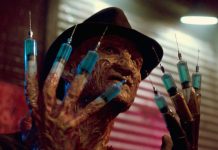
At the time of its release, a publication no one remembers called Nightmare 2, “the gayest film ever made,” and they didn’t mean it kindly. Since then, it has embraced its place in LGBTQ+ horror history. The film bleeds with the identity crisis of youth: pitting Jesse in an internal struggle against Freddy as Freddy hacks and slashes the male cast down to pieces. In this sequel, Freddy is the metonymy of the self-hate for 1980s youth who struggled with sexual identity. It’s a deep meaning for a superficially campy film: knocking its way through bedroom sing-a-longs, BDSM clubs, shower sequences, and an awkward yet endearing moment in which Jesse runs from the kiss of his would-be girlfriend to instead spent time with his best guy. Mark Patton’s Jesse was the very first male scream queen, and what used to be a moment of shame for the actor has been embraced and celebrated in recent years.
7Heavenly Creatures (1994)
An intense, fantastical psychological thriller, Heavenly Creatures makes the list for its sheer commitment to the reality of young love. Juliet, a 13-year-old socialite, and Pauline, a 14-year-old working class girl, bond in friendship over their shared childhood illness and love of fantasy. As they create a mythical world in their minds, Juliet and Pauline cast themselves as the ruling couple. Their vehement imaginations carry them past the real world, and their intent turns murderous when their parents threaten to take them away from each other. The suspected homosexuality of Pauline lands her in a doctor’s care (the film takes place in the 1950s), driving a greater wedge between herself and her mother. Their external illnesses are only treated by their acceptance and love for one another as they fantastically make up ways their fictional characters make love.
Throughout the film, there is an overlying theme of the fractured heterosexual relationships, with Pauline’s father being nearly absent and Juliets’ parents on the brink of divorce. It’s escapist and engrossing, candy-colored and surreal, and despite their mania, the love between the two girls is sweet, substantial, and real.
8Hellbent (2004)
Hellbent broke out of the LGBTQ+ film festival circuit to mainstream appeal due to its strong slasher homage. Although not the first of its kind, it was the first to target the LGBTQ market directly before moving to the mainstream, and was a major player in starting the “queer horror” movement in the following years.
Taking place at a West Hollywood Halloween Carnival, a killer in a devil mask is on the loose and, well, chaos ensues. There are moments of levity: when the gang first sees the killer at the previous night’s crime scene, they taunt him for “cruising” them. There are also moments of emotional grief as Joey is turned down by his long-term crush before being decapitated. The film plays with genuine slasher tropes, building a core collective of characters that get swiped down one-by-one, and ending with the classic “not-dead-yet” nod we’ve come to expect from the subgenre. It takes itself seriously as a horror film which is why it was embraced beyond its original festival run and stands firmly as a catalyst for many queer horror film since, and many more to come.
9Lyle (2014)
Lyle has been called the queer Rosemary’s Baby, with themes of paranoia and grief resonating from pregnancy. The film is taut with psychological drama, and manifests with a slow-burn effect that never relents in keeping us entertained. The story goes as such: Leah moves to Brooklyn with her young daughter, Lyle, to live with her record-producer wife, June. She is also newly pregnant. Early on in the film, the soul-crushing death of Lyle in a preventable but understandable fashion leaves Leah pained and grief stricken. She is tended to by a pregnancy-obsessed neighbor, Karen, and befriended by a model who lives upstairs. Both friendships are unsettling and add to the increasing paranoia and frenzy of the pregnant mother. The horrors vacillate between natural and supernatural in Leah’s mind as she dives deeper in the history of child death in the Brooklyn apartment home, and determines the place is the source of the evil penetrating her life.
Without spoiling anything, director Stewart Thorndike ends the film with a shock less revealing than Polanski, but just as satisfying. He also has a keen sense of storytelling, where the lesbian couple is incidental to the events, and not a concerted focus on queer identity. These are parents suffering a loss, and also preparing for the new child ahead of them, and the struggles of any relationship amplified to horrific effect.
10What Keeps You Alive (2018)
What Keeps You Alive falls into the recent trend of horror cinema of deep-seeded family secrets upending the status quo of current relationships. The film centers around Jules and Jackie, a lesbian couple celebrating their one year anniversary in the woods. What was to be a romantic getaway quickly becomes unnerving as Jackie’s past isn’t what it appears to be. It’s a welcome twist on the classic female serial killer, as historically women fall into two general multiple murderer categories: angel of death or black widow. Jackie is the latter but instead of murdering husbands, she’s murdering wives. She’s not just a crazy person though. She’s caring throughout the chaos, a chilling psychopath wrapped in a bow of granola. Jules is equally scrappy and cunning, and her desperation to survive is juxtaposed with the love she still feels for her year-long relationship.
By melding historically accurate accounts of female serial killers with modern acceptance of gay and lesbian culture, the film is a fresh experience, and ultimately just a damn a good horror movie.
Related Article: Review: Don’t Look Away from these ‘Dolls’!