




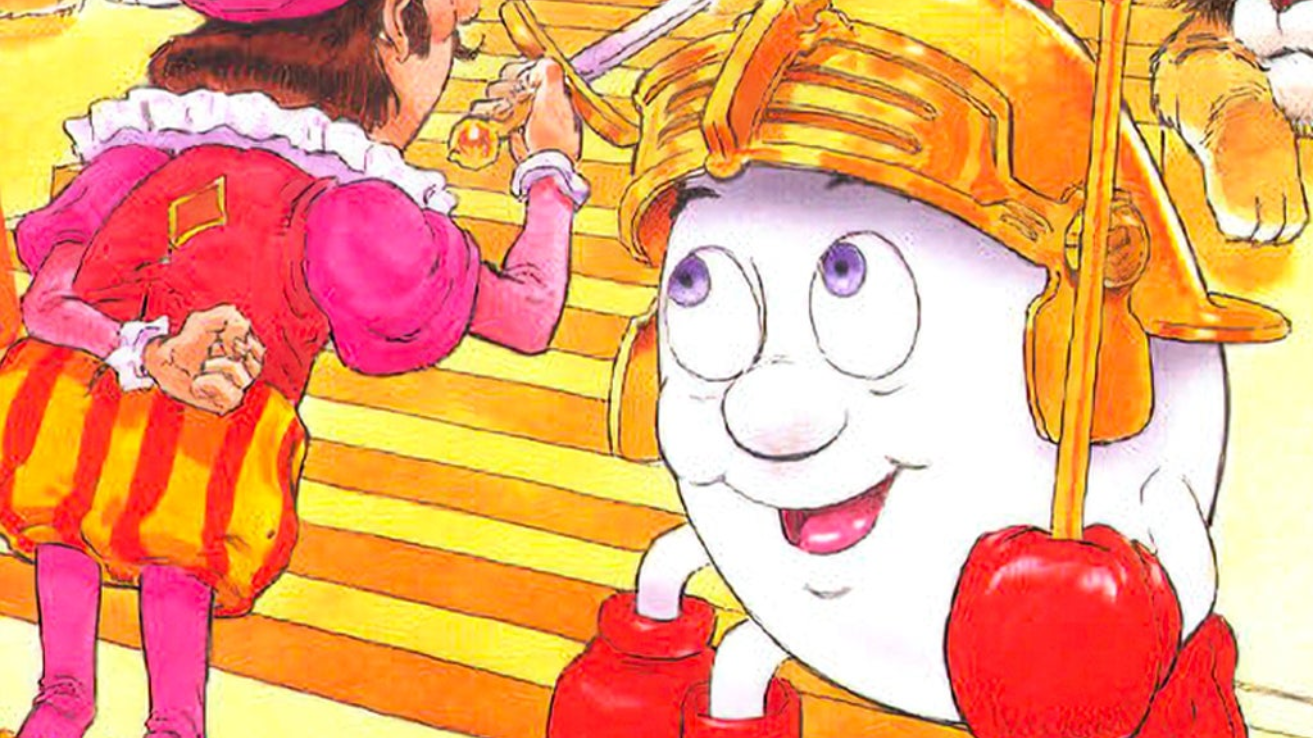
Hands up, how many of today’s gamers remember Dizzy, the flip-flopping, side-scrolling little egg who stole our hearts back in the late 1980s? If you answered “yes,” how old do you feel when we tell you that this month he turns 30? That’s right, the savior of The Yolk Folk has been a fixture of home gaming for three decades; amazingly, he’s as fresh as the day he popped out of some chicken’s bum.
To celebrate this egg-citing milestone, we look back at the history of this often-overlooked hero of the gaming world and recall his humble beginnings at Codemasters and his rise to the proverbial golden egg that always lands sunny side up.
1987: The Ultimate Cartoon Adventure Begins
Our hero started life on the back of a roll of wallpaper. The year was 1987, and Philip and Andrew Oliver were drawing up their latest side-scrolling adventure, Dizzy: The Ultimate Cartoon Adventure. The game featured a face with hands and feet who cartwheeled himself from screen to screen, chasing Leprechauns for their wigs and Trolls for their grog. In doing this, our hero, who The Oliver Twins named Dizzy, could concoct a potion to help rid the kingdom of Katmandu of the Evil Wizard Zaks.
The game was a massive success. It would be voted the 5th best title for the ZX Spectrum and eventually one of the 10 most influential Spectrum games of all time. This should come as no surprise.
Before the release of Dizzy: The Ultimate Cartoon Adventure, The Oliver Twins, who had started writing code while at school, were responsible for 7% of all UK game sales. In the years after the release, The Oliver Twins had 10 UK number-one bestselling games and smashed over 3 million sales.
1988: Treasure Ahoy
A little over a year later, in August 1988, Codemasters released the first Dizzy sequel, Treasure Island Dizzy. Bowing to public opinion, Codemasters and The Oliver Twins elected to turn Dizzy into an egg, agreeing that the limited sprites within the original game had, in fact, looked an awful lot more like an egg than a face.
Unlike its predecessor, Treasure Island featured a much more puzzle-based gameplay style. This would become an intrinsic theme of the Dizzy games, but for 1988, it was considered rather complex and reduced many gamers to assault the eggs they had in their own fridge out of frustration. Or was that just me?
1987: Bacon Mushroom & Eggs
Later, in 1987, Codemasters released Fast Food Dizzy (sometimes just called Fast Food), which was a Pac-Man port, and as we’ve all played Pac-Man, there’s really no explanation needed. Instead of the traditional ghosts, our hero is pursued by demonic mushrooms named Bonzo, Wizza, Pippa, and Fido.
1989: Let Me Be Your Fantasy
Fantasy World Dizzy was released in October 1989, and for many Spectrum/Amstrad gamers, this was the true third installment in the series. Fantasy World Dizzy was great for many reasons, primarily because it introduced us to Dizzy’s bonkers family and friends: Daisy, Denzil, Dozy, Dylan, and Grand-Dizzy. Collectively, these new characters became known as The Yolk Folk.
Fantasy World Dizzy would also introduce some elements to the gameplay that would remain unchanged throughout the remainder of the core series. Here, players were gifted three lives (imagine that) and a much easier inventory tool that allowed for multiple items to be carried at once. The Oliver Twins really began to hit their stride around this time.
1990: Feeling Hungry? Have Kwik Snax!
The dawn of the ’90s would bring with it several spin-off titles, the most notable of which was 1990’s Kwik Snax. Kwik Snax was an unofficial follow-up to Fast Food and was one of the games my mum used to play when she was hogging the Amstrad back in the day.
Dizzy Panic! (a Tetris style game), and Bubble-Dizzy were released the same year.
1990: It’s A Kind Of Magic
Also, in 1990, Codemasters released Magicland Dizzy. Officially described as the 4th installment in the series, Magicland was also notable as it was the first Dizzy game not entirely developed by The Oliver Twins, who were targeting the American market by now. Instead, the coding of Magicland Dizzy was contracted out to Big Red Software.
A free-to-play prequel (Dizzy 3.5) and a 1993 remake (Wonderland Dizzy) were also released.
1990: Spellbound
Spellbound Dizzy, released for Christmas 1990, is infamous in the Dizzy series because it was so hard that fans actually resorted to cheating to complete it. As far as we know, Spellbound became the first Dizzy game where players could utilize ‘patches’ to get around some of the harder elements. And oh boy, did Spellbound have some tough elements!
For the first time in the character’s history, life force could be lost by falling from a height. That might not seem particularly difficult to avoid, but in Spellbound Dizzy, you fell. A lot.
Dizzy Down the Rapids—a spin-off clone of Toobin’—was released around the same time.
1991: Prince Of The Yolk Folk
Codemasters were busy in 1991. Not only did they release the Spellbound title, as well as Down the Rapids, but they also threw together Prince of the Yolk Folk, which would later be re-released as Dizzy The Adventurer.
The game was released on the ill-fated Aladdin Deck Enhancer, which Codemasters had developed for Nintendo’s original console, the NES.
1991: C’est Fantastique
Don’t get your eggs in a scramble, but the evil Wizard Zaks has kidnapped your egg-tra sexy girlfriend Daisy and taken her to his castle in the clouds. Big Diz’ gets all Super Mario in 1991’s Fantastic Adventures of Dizzy.
1992: Crystal Kingdom
Crystal Kingdom Dizzy was expensive at the time, retailing at over £9.99. In contrast, all previous games cost around £3, but nothing was immediately obvious to differentiate this latest title from any previous.
Regardless of this fact, people went out and bought it anyway. In fact, it outsold Rainbow Island and Street Fighter II in the UK.
1993 & Beyond: Insert An Egg-Cellent Pun Here
The series went quiet after 1992. Several collected editions were released, and versions appeared on new platforms under new titles but were simply repackaged original titles.
Several attempts have been made to resurrect the egg, most of which have failed. In particular, The Oliver Twins set up a Kickstarter to fund a new sequel but made £25,000 of their £350,000 goal. That’s more than likely due to the fact that Dizzy has been quiet for so many years that most gamers need a nudge to remember him.
It also can’t have helped that he existed almost exclusively on long-dead platforms like the Spectrum or Amstrad. Things may have been very different had he made it big with SEGA or Nintendo.